Muscle Wasting in Old Dogs: Why It Happens and What Actually Slows It
Medically reviewed by Cynthia Lankenau, DVM, GDVWHM, ACVHM, CVA, RH (AHG), MS-TCVM, FACVBM — For general education — not a substitute for veterinary care.
Muscle wasting in an old dog is rarely just "getting old" — it's measurable, it's gradual until it isn't, and catching it early changes what you can still do about it.

On this page
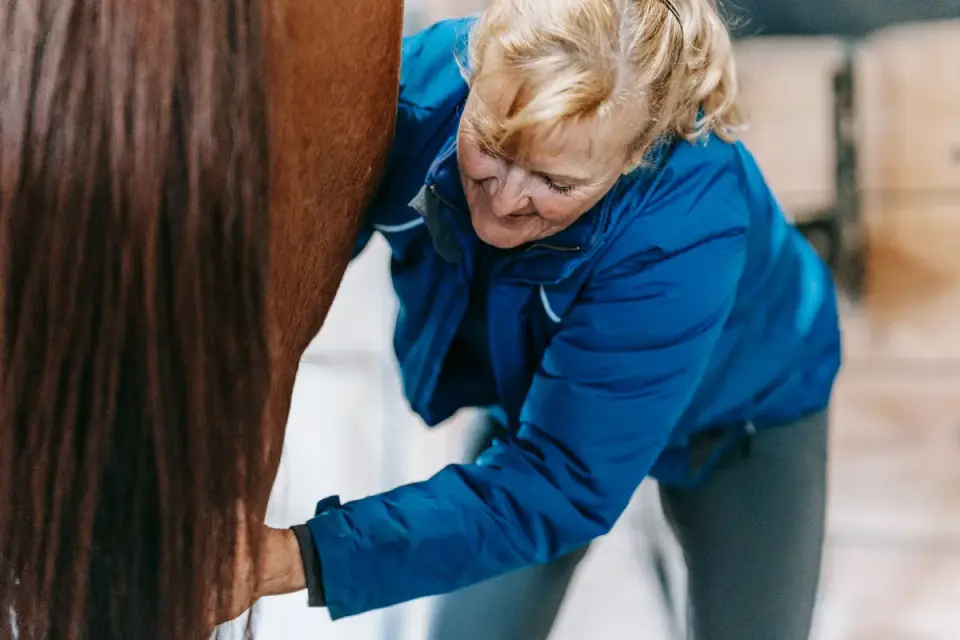
The first time I laid a hand flat along a twelve-year-old Lab’s lumbar spine and felt bone where there used to be a firm ridge of muscle, the owner in the room hadn’t noticed a thing. She’d been watching his waistline, his appetite, his energy on walks — all reasonable places to look. What she hadn’t been tracking was the muscle itself, and by the time it’s visible to the eye, a dog has usually already lost a meaningful fraction of what he had at seven. That gap between “still eating fine” and “losing muscle” is where most owners lose the early window, and it’s the reason I now put a hand on every senior patient’s spine, scapulae, and hindquarters before I say anything else about how they’re aging.
Bottom line first: muscle wasting in an old dog is a distinct, trackable process (sarcopenia when age-driven, cachexia when disease-driven), and the two levers with real evidence behind them are a muscle condition score done at every visit and a protein intake that’s actually adequate for an aging body, not just an adult-maintenance minimum. Everything else — supplements, exercise tweaks, diet timing — sits downstream of getting those two things right, and I’ll defend that ordering below, including where I think it runs against common practice.
What’s actually happening under the coat
Sarcopenia is age-related muscle loss that occurs independent of disease; cachexia is muscle loss driven by an underlying illness such as heart failure, kidney disease, or cancer, and it can also strip fat, which sarcopenia typically does not. Both matter clinically because they’re linked to worse outcomes, not just cosmetic thinning — a 2012 review in the Journal of Veterinary Internal Medicine by Freeman, Journal of Veterinary Internal Medicine: Freeman describes cachexia and sarcopenia in dogs and cats as emerging syndromes of real clinical importance, tied to increased morbidity, and notes that healthy geriatric dogs show measurably lower epaxial (spinal) muscle mass than healthy young dogs even without disease present.
I think from the botanical and TCVM side of my training as much as from the biochemistry, and the two frames actually agree here: a body that is losing muscle is a body whose Qi and blood aren’t being transformed and distributed as efficiently as they once were, and in Western terms that’s a mix of declining anabolic signaling, lower physical activity, and — in a meaningful share of senior dogs — inadequate dietary protein relative to what an aging gut can actually absorb and use. Neither framework treats this as inevitable decline you simply watch happen. Both treat it as something you assess, name, and act on.
How to actually catch it before it’s obvious
This is where I part ways with a lot of well-meaning owner advice, which tends to fixate on body condition score — the fat-and-rib assessment most people already know. Body condition score tells you almost nothing about muscle. The tool that does is the muscle condition score developed through the WSAVA Global Nutrition Committee, a four-point scale (normal, mild loss, moderate loss, severe loss) built on palpating the skull, scapulae, spine, and pelvis, and it’s designed to take under two minutes as part of a routine exam according to the WSAVA Nutritional Assessment Guidelines. I ask every owner of a dog past seven to learn to run their own hand along that spine and those shoulder blades between visits, because the trajectory between two vet visits six or twelve months apart is exactly the window where you still have room to intervene.
Researchers evaluating methods to detect sarcopenia in aging dogs, published in the American Journal of Veterinary Research, found the same pattern clinically: identifiable, measurable muscle loss shows up in geriatric dogs using standard techniques, even though the underlying mechanisms driving it in otherwise-healthy aging dogs aren’t fully mapped yet (see the study on assessing sarcopenia in old dogs). Related work on canine muscle loss and back-leg weakness covers what this looks like in the hindquarters specifically, which is usually where owners see it first — read more in Dog Losing Muscle in Back Legs: What It Means and When to Worry.
The protein question, and why “senior formula” isn’t a real answer
Here’s the part where I’ll be blunt: there is no NRC-defined nutrient profile specific to senior dogs, so most “senior” diets are simply adult-maintenance formulas with lower calories and, often, lower protein — the opposite of what an aging, sarcopenia-prone body typically needs. Multiple lines of research point the same direction: elderly dogs appear to need more dietary protein than younger adults to maintain nitrogen balance and lean mass, not less, and reduced protein utilization efficiency with age is part of why. That’s a real physiological headwind, not a marketing claim, and it means the “less protein for aging kidneys” instinct many owners carry from outdated advice can actively work against muscle preservation in a dog without diagnosed kidney disease. I’d rather see an owner ask their vet for an actual protein target in grams per kilogram of body weight than trust a bag that says “senior” on the front.
In my practice, this shows up almost weekly with a specific shape: an eight- or nine-year-old dog, often a retriever or setter type in the 55–75 pound range, whose owner switched to a “senior” or “weight management” kibble around age seven because the internet said to, and who now, eighteen months later, is bringing the dog in because the topline looks different and the dog is slower getting up from the kitchen floor after naps. When we run a diet history alongside the muscle condition score, the protein content has almost always dropped, sometimes by a third. We’re not always dealing with disease. We’re often dealing with a well-intentioned diet change that quietly starved an aging body of the one macronutrient it needed more of, not less.
Where structure-function ingredients fit — and where they don’t
I want to be precise here, because this is a category where it’s easy to oversell. Antioxidant and NAD+-precursor ingredients — nicotinamide riboside, quercetin, resveratrol, and similar compounds now common in senior-dog chews — are studied for cellular and metabolic support, not as treatments for sarcopenia itself, and I won’t frame them otherwise. Tracing a compound’s plausible benefit outward from the plant or precursor to the whole patient is the exercise I do with owners in the room, and it’s also where I stop them from over-reaching.
Quercetin is a flavonoid studied for antioxidant, immune, and cellular support properties. It’s worth naming the limits of the current evidence honestly: research using quercetin formulations alongside NAC and ascorbic acid found that, at the concentrations tested, these compounds did not affect feeding behavior in the model organism studied, per research published via DOI.3390/ph19040525 — a useful reminder that in vitro and invertebrate-model findings don’t automatically translate to muscle outcomes in a dog. Resveratrol, often paired with quercetin in these formulations, is likewise studied as an antioxidant supporting cellular health and vitality rather than as a muscle-building agent; one embryonic-exposure study at 50 μg/ml found that early-life exposure accelerated developmental timing but shortened adult lifespan in the organism studied, which is a caution about dose and life stage in that model, not a finding in dogs, from research at DOI.1016/j.phymed.2026.158531.
None of these ingredients replace a muscle condition score, a protein target, or a workup for underlying disease when cachexia is on the table — they’re, at best, a reasonable adjunct alongside adequate protein and monitored exercise. For deeper reading on what these ingredients can and can’t credibly claim, see Sarcopenia in Dogs: What Muscle Loss Actually Means and What Helps and Canine Cognitive Dysfunction Supplements: What the Evidence Actually Supports.
What I tell owners to actually do
Short version, because this part doesn’t need embellishing: get a muscle condition score at every visit past age seven, ask your vet for a specific protein target rather than trusting a “senior” label, and keep resistance-style movement — stairs, hills, sit-to-stand reps — in the routine for as long as it’s safe, because unused muscle disappears faster in an aging body than a young one.

I think about a nine-year-old Shepherd mix I worked with a while back, sixty-one pounds, whose owner’s first clue wasn’t weight loss on the scale — it was that the dog had stopped jumping into the back of the car unprompted, something he’d done without hesitation for years, and had started needing a pause and a running start on the stairs to the porch. That change had crept in over roughly four months, easy to miss day to day and unmistakable looking back. His muscle condition score came back moderate loss over the epaxial spine and pelvis, his bloodwork was otherwise unremarkable, and his diet history showed a protein-light “senior” kibble switch about a year prior. We didn’t reverse the clock, but between a protein-adequate diet, a return to daily incline walks, and reassessment every ten to twelve weeks instead of once a year, his owner reported he was back to clearing the tailgate within a few months — one dog’s outcome, not a promise for every dog, but it’s the kind of trajectory that’s only possible when someone catches the muscle loss instead of chalking it up to “just getting old.”
If your dog’s muscle condition score is dropping and there’s no diet or activity explanation for it, that’s the point to loop in your veterinarian for bloodwork and a broader workup — cachexia from underlying disease needs a different plan than age-related sarcopenia, and telling the two apart isn’t something to guess at from the couch. For more on distinguishing the two and what’s realistic to expect from intervention, see Do Vets Recommend NAD+ Supplements for Dogs? What the Evidence Actually Supports.
Frequently asked questions
Is muscle wasting in an old dog always a sign of disease?
Not always. Age-related sarcopenia can occur in otherwise healthy dogs, but if muscle loss is rapid or paired with weight loss, appetite change, or lethargy, it can signal cachexia from an underlying condition like heart failure, kidney disease, or cancer, and warrants veterinary bloodwork.
How do I check my dog's muscle condition at home?
Run a flat hand along the spine, over the shoulder blades, and across the hips and pelvis. Sharp, easily felt bone with little muscle padding suggests loss; a firm, rounded muscle ridge suggests normal condition. This isn't a replacement for a vet exam, but it helps you track changes between visits.
Does more protein help an aging dog keep muscle?
Current research suggests older dogs often need more protein, not less, to maintain lean mass, since aging can reduce how efficiently the body uses dietary protein. Ask your vet for a specific protein target rather than assuming a "senior" label diet is adequate.
Sources
- Cachexia and Sarcopenia: Emerging Syndromes of Importance in Dogs and Cats — Freeman, Journal of Veterinary Internal Medicine
- WSAVA Nutritional Assessment Guidelines — WSAVA
- Assessment of methods of evaluating sarcopenia in old dogs — American Journal of Veterinary Research
- Quercetin feeding behavior study — DOI:10.3390/ph19040525
- Resveratrol embryonic exposure study — DOI:10.1016/j.phymed.2026.158531